
Devlu Holidays


The argument in favor of using filler text goes something like this: If you use real content in the Consulting Process, anytime you reach a review point you’ll end up reviewing and negotiating the content itself and not the design.






Sacred water of this kund (pond) is believed to have been generated by Baba Lakhmir Das Ji by striking earth with his chimta. This story of faith, of great tradition and of great healing power has been intact and being followed by generations.
Introduction
A place Charan Ganga, also know as Chimta Sahib, is a hidden holy pool located in Dhramshala village near Samtana, in the Hamirpur district of Himachal Pradesh. Although it look like a simple village pond, it is highly sacred to the local people. The history of this place is deeply connected to a holy figure named Baba Lakhmir Das ji, whose stories have been connected shared by locals for generations. According to the temple records, Baba Lakhmir Das Ji once struck the ground with his chimta, and water came out from that place. This is believed to be the origin of the kund. In Himachal Pradesh, people commonly know it as Chran Ganga, while many people from Punjab know it as Chimta Sahib
It is also believed that water of this kund can cure different skin problems. Even today people from far off places visit this hidden heritage and after taking bath in its water render thanks and pray with faith. For local community it is not a simple water body; it is a symbol of faith, of history and of great tradition.
In this article I aim to explore the history and significance of the little known site of the Chran Ganga (Chimta Sahib) and in particular the connection to Baba Lakhmir Das Ji and the appearances of the water to this day and why people continue to visit this hidden heritage site.Who Was Baba Lakhmir Das Ji?
The life of Baba Lakhmir Das Ji is connected with Tapp Wala Dera, which is located in Bathinda, Punjab. However, there is no written information available about his parents in the texts related to his life.
When Baba Lakhmir Das Ji was around six or seven years old, he started living with his guru, Baba Nihal Das Ji, at Tapp Wale Dere in Bathinda. From a very young age, Baba Lakhmir Das Ji spent his time in prayer and devotion to God.
In a very short time, stories about Baba Lakhmir Das Ji and his spiritual powers began to spread to nearby places. One day, in a village near Bathinda, a family was taking the dead body of a child for cremation. Seeing the family crying and heartbroken, Baba Lakhmir Das Ji felt very sad.
Baba ji sprinkled water from his kamandal on the child,and the child suddenly woke up. Baba Ji then said, “He was only sleeping. I just woke him up.”
When people saw this, the news of Baba Ji’s miracle spread quickly. Baba Ji, however, simply started playing with the child. The people of the village ran towards Tapp Wala Dera and told Baba Ji’s guru, Baba Nihal Das Ji, everything that had happened.
By that time, Baba Lakhmir Das Ji also reached the dera with the child. Seeing this, Baba Nihal Das Ji said to him:
“Lakhmiya! You have changed what God had decided. I already knew that you had this power within you. But now people will start bringing dead bodies here, hoping that you will bring them back to life. How many dead people will you bring back to life? This will make your life difficult. So leave this place now and go to the mountains. Find a place where nobody knows you and where there is no settlement. Stay there and spend your time in prayer.”
Following the order of his guru, Baba Lakhmir Das Ji bowed before Baba Nihal Das Ji and left for the mountains.
According to the local people, there were five wells in Bathinda at that time. It is said that when Baba Lakhmir Das Ji left Bathinda, four of the wells dried up, while only one well still had water.
On hearing this, Baba Nihal Das Ji said:
“Lakhmiya has taken the water of four wells with him in his begging bowl.”
According to the records, Baba Lakhmir Das Ji brought the water from these four wells to Himachal Pradesh and released it in the form of natural springs. It is believed that these springs are still flowing today without any interruption.
Baba Ji’s Arrival in Himachal Pradesh
After leaving Bathinda, Baba Lakhmir Das Ji travelled through many different places before reaching Himachal Pradesh. Wherever Baba Ji stayed, people witnessed his spiritual powers and became his followers. Many people started following him and became his dedicated devotees.
According to the saying “Dhuni Pani Sidhon Ki Bani,” a spiritual person chooses a place to stay where there is enough wood for the dhuni (sacred fire) and water for drinking, while food is left to the care of God. At this particular place, there was plenty of wood for the dhuni, but there was no water available for drinking.
Baba Ji’s followers searched the surrounding area for water, but they could not find any. Everyone became disappointed. Seeing this, Baba Ji struck the ground with the chimta in his hand. As recorded in the temple texts, a stream of water suddenly came out of the ground and started flowing. It is believed that this water is still flowing today. Because of this event, people started calling the place “Chimta Sar.” The main difference today is that a baudi (a traditional water structure or well) has been built at the spot where the water emerged.
Baba Ji’s Journey Towards Hari Tilanghar
After staying there for some time, Baba Ji continued his journey towards the village of Hari Tilanghar. The village is located on the Shimla–Hamirpur Highway, directly opposite Chran Ganga (Chimta Sar).
One day, while Baba Ji was passing near the settlement outside the village, heavy rain suddenly started. Baba Ji took shelter near the house of an old woman and stood there to protect himself from the rain.
However, the old woman did not know who Baba Ji was. She asked him to leave and said, “Baba, have you come here to steal in the daytime?”
Baba Ji became very angry after hearing this. He walked some distance away from the place and stopped there. Then he said, “Maai, what are you waiting for now?”
According to the records, as soon as Baba Ji said these words, the houses in the settlement caught fire and started burning, even though it was raining heavily at the time.
Baba Ji then gave a curse to the settlement. It is said that there would be only one son in each family, and he would live separately. Even if a family had more than one son, they would not be able to live together and would have to live separately.
According to local belief, this curse is still said to continue today. People in the settlement of Hari Tilanghar say that the children of different families still live separately rather than staying together in the same place
The History of Chimta Sar (Chran Ganga, Chimta Sahib)
Baba Ji spent time in meditation and prayer at Chimta Sar, and gradually, stories about his spiritual powers began to spread in the nearby areas. People from many villages became his devoted followers.
Among them was a Brahmin from Hari Tilanghar village, who worked as a halwai (sweet maker) and was also a devoted follower of Baba Ji. One day, he come to Baba ji and said, “Baba ji, please come with me to Amritsar (Punjab) for holly bath”
Baba ji refused to go but the man kept insisting. Finally, Baba Ji said to him, “Pandit Ji, you go ahead. I will also reach there.”
The Brahmin then travelled to Amritsar, took a holy bath there, and stayed for about a month. During his stay in Amritsar, the Brahmin opened a small jalabi shop and ran for a month, he earned a good amount of money He was happy with the money he made. But he felt sad because Baba ji did not come to meet him as promised.
Then it was time to go back to his village. Another thing happened. He was taking a bath in the holy water tank at Amritsar. His water pot fell into the water by mistake. He could not find it. So, he started his trip back home.
On the way he was happy about the money he had earned money, but he was also upset about losing his lotta (water pot) and not being able to meet Baba ji.
Before going home, Pandit ji decided that he would first visit Baba ji, offer him some money, and asks him why he had not come to Amritsar as he had promised, and he did the same, he went to Baba ji and asked “why didn’t you come to meet me despite promising?”
Baba Ji replied, “The place where you were taking your bath, I was also taking a bath at the same place, right in front of you.” Hearing this, the Pandit was surprised. He could not understand how Baba Ji had been there, yet he had not been able to see him.
Baba Ji then asked him, “Apart from this, was everything else fine?” The Pandit replied that his lotta (water pot) had fallen into the Amritsar Sarovar and he had not been able to find it.
Baba Ji then told him, “Go and take a bath in the water in front of you, and you will find your lotta there.” This was the same water that Baba ji have brought out of the ground by striking it with his chimta. When the Pandit ji went into the kund to take a bath, he was surprised to see the Amritsar Sarovar in front of him He could see people bathing there, just as he had seen them bathing in the Amritsar Sarovar He also saw a large number of water pots lying in the water. The Pandit was completely surprised by what he saw.
After coming out of the water, the Pandit fell at Baba Ji’s feet and placed the lotta he had found in the water before him. Baba Ji then said, “Pandit Ji, this money and this lotta are of no use to me. Take them back. Now you have only one duty—to tell other people about this place.”
As recorded in the temple texts, Baba Ji then gave a blessing and said that whoever came to this place with faith, took a bath in the water and left a piece of clothing behind would be relieved of different skin problems. This belief became an important part of the tradition of the place.
Baba Ji also said that he would now leave this place because the people from the nearby village had started troubling him too much. He then left the place and moved about one kilometre further into the forest, where he set up his new place of meditation. Even today, people are believed to come from faraway places to take a bath in the water. Many visitors also leave a piece of their clothing at the site as part of the tradition.
According to local belief, the words and blessing of Baba Ji continue to guide people even today. It is also said that from this time onwards, the place became known as “Amritsar.” Today, different people use different names for the place. Some call it Amritsar, some Chimta Sar, and others Charan Kund or Chran Ganga.

Baba Ji’s Departure from Chimta Sar
After leaving Chimta Sar (Chran Ganga, Chimta Sahib), Baba Lakhmir Das Ji continued his journey towards the forest. While travelling, he reached a village which is know as “Turan”
When Baba ji reached the village, he asked for a place to stay. However, the local deity, known as Dhuddu Sidh, did not allow Baba Ji to stay there.
According to the local story, Baba Lakhmir Das Ji became angry and gave a curse to Dhuddu Sidh. He said that from that day onwards, only the people of Turan village would worship Dhuddu Sidh, and people from other villages would not follow or worship him. Baba Ji also said that the blessings of Chimta Sar (Chran Ganga) would not benefit the people of that village.
Dhuddu Sidh became angry after hearing this and, according to the story, gave Baba Lakhmir Das Ji a curse in return. He said that after six generations, Baba Ji’s lineage would come to an end.
According to local belief, both of these curses are still considered to be true. People of Turan are said to have their own connection with Dhuddu Sidh, while people from nearby villages follow other local spiritual places and deities.
There is also a belief that the people of Turan do not receive the same benefit from the water of Chran Ganga, while people who come from faraway places visit the kund, take a bath and believe that they receive relief from their health problems.
Even today, Dhuddu Sidh is mainly worshipped by the people of Turan village, while many people from the surrounding areas worship Tlyangar Sidh, located in Hari Tlyangar.
Baba Lakhmir Das Ji’s Samadhi
After all these events, Baba Lakhmir Das Ji finally settled in a place surrounded by forest. This place is now known as Dharamshala, near Samtana in Hamirpur district of Himachal Pradesh.
Baba Ji spent the later part of his life at this place. According to the records, he left his physical body here, and a samadhi was built at the same place in his memory. This site later became an important place for the people.
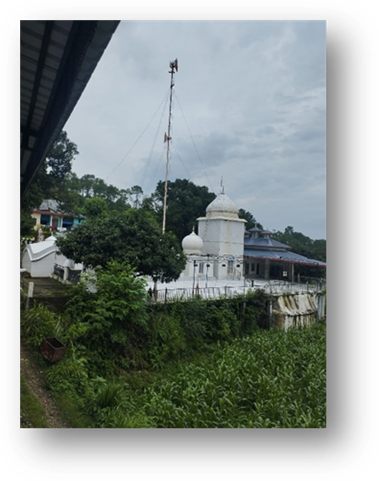
Every year, the Baisakhi festival is celebrated here with great enthusiasm. People from Himachal and Punjab visit the temple to pay their respect and take a bath in the scred kund. The temple and kund are also maintained and looked after with the support of the temple prieste and local community.A trishul (trident) of Lord Shiva, placed as a Nishan Sahib, has also been installed at the site.
Today, the samadhi, temple and kund together form an important part of the local heritage connected with Baba Lakhmir Das Ji, and continue to attract devotees from different places
Every year during the Baisakhi festival, the cloth covering the trident and the flags placed on top of it are changed. Devotees consider the old cloth as a blessing and take a piece of it with them as a sign of faith.
There are some pictures of Temple:

Things You May Want to Know About Chran Ganga
1. Did Baba Lakhmir Das Ji really bring out the water by striking the ground with his chimta?
According to the local tradition, yes. It is believed that Baba Lakhmir Das Ji struck the ground with his chimta and water came out from that place. Even today, the water at Chran Ganga is believed to be flowing continuously, just as it did during Baba Ji’s time.
2. Can bathing in Chran Ganga help with skin problems?
According to the local belief, yes. People who visit Chran Ganga with faith and take a bath in its water believe that it helps them get relief from different skin problems. This belief has been passed down for a long time. People still visit the water pool for this reason.
According to local history and stories, yes. People belive that baba Lakhmir das ji cursed the local community. Because of this curse, the local people do not get any health benefits form the water. However, people from other place still visit the pool. They believe that bathing in it helps them.
4. Did the nearby deity, Dhuddu Sidh, curse Baba Lakhmir Das Ji that after his sixth generation would come to an end?
According to the local belief, yes. The story says that Dhuddu Sidh cursed Baba Lakhmir Das Ji and said that after six generations, his lineage would come to an end. According to the belief shared by local people, the seventh generation of Baba Lakhmir Das Ji is said to have already come to an end.

